
Your Cart is Empty
No need to buy OEM and pay 2x the price.
Nilfisk Advance VA75006, Pick-up tool mounting plate
FactoryCat/Tomcat 290-234A, Spare Key Set of 2 Keys
Glad I was able to purchase this item.
Free Shipping on Parts Orders Over $99
Free Shipping on Parts Orders Over $99

July 19, 2026 3 min read
The rules in this article apply to machines using multi-battery banks (Series/Parallel configurations). If you operate compact scrubbers powered by a single isolated battery unit, a single-battery replacement is standard practice.
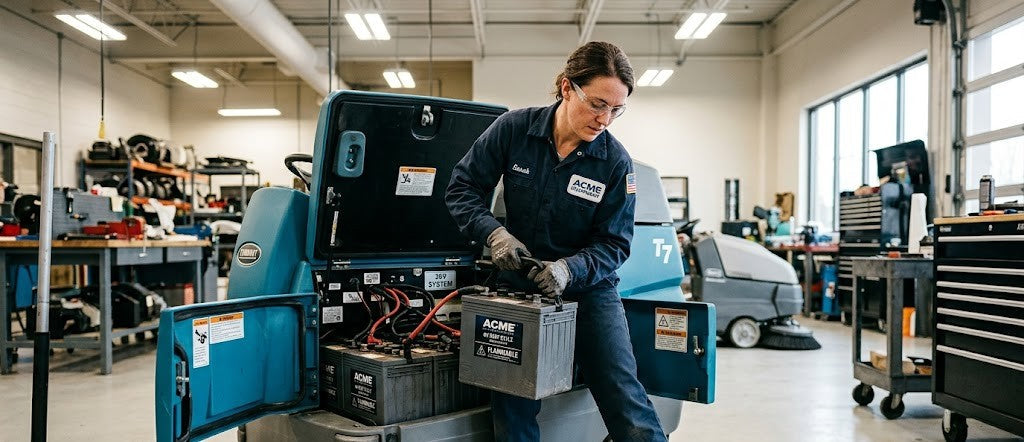
It is a tempting shortcut: one battery in your pack dies, or a couple of cells seem weak, so you order a single, brand-new replacement block to swap into the existing set. On the surface, it feels like a smart, budget-friendly fix.
In reality, you are setting that brand-new battery up for an early grave.
If you drop a brand-new battery into an older set—specifically one with 50 or more cycles on it—you aren't extending the life of your pack. Instead, you are introducing a sacrificial lamb to a highly volatile electrical environment. Here is the science behind why that new battery will be chronically overcharged and fail prematurely.
To understand why mixing states-of-charge and age is dangerous, we have to look at how batteries age. As a battery pack goes through dozens of charge and discharge cycles, its internal chemistry changes.
Internal Resistance Rises: Over time, active materials inside the older batteries degrade, leading to a higher internal resistance.
Capacity Drops: Older batteries simply can't hold the same amount of total energy as they did on day one.
Higher Finish Rates Required: Because of the increased resistance and altered chemistry, older batteries require a higher "finish rate" (a higher voltage or sustained current at the end of the charging cycle) to fully accept a charge and reverse sulfation or cell imbalance.
When you introduce a brand-new battery into this seasoned environment, you create an immediate, severe imbalance.
Smart chargers look at the battery pack as a whole, or they regulate charging based on the average feedback of the system. Because the overall pack consists of older batteries that require a heavy, high-voltage push to cross the finish line, the charger will pump out higher rates to satisfy them.
Here is what happens next to your new battery:
The new battery has low internal resistance and pristine chemistry. It reaches full capacity much faster than its older siblings. However, because the charger is still trying to force the older batteries to their required finish rate, it keeps pouring energy into the entire string. The new battery is forced to absorb this excess energy, leading to chronic overcharging.
Overcharging creates intense internal heat and causes the electrolyte inside the new battery to boil or outgas. In sealed batteries (like AGM or Gel), this causes bloating and permanent dry-out. In flooded batteries, it rapidly accelerates water loss.
The combined heat, pressure, and electrical stress degrade the new battery's grids and active material at an exponential rate. Within weeks or months, your brand-new investment will fail, often dying before the older batteries you were trying to save.
To get the longest lifespan and best ROI out of your battery banks—whether they are for golf carts, solar storage, marine vessels, or aerial lifts—abide by these industry rules:
Keep Matched Sets: Always replace batteries in full sets, or at the very least, matched strings of the same age, brand, and cycle history.
The 50-Cycle Cutoff: If a battery pack has fewer than 20–50 cycles, you might safely get away with replacing a single damaged cell (e.g., a factory defect). Once a pack crosses the 50-cycle mark, its chemistry has shifted too far to safely integrate a new block.
Rotate and Clean: Ensure proper terminal connections and clean busbars to prevent artificial resistance from throwing off the charger's readings.
The Bottom Line: Trying to save money by replacing a single block in an old set is a textbook example of being penny-wise and pound-foolish. Treat your battery pack as a single, unified organism. When it’s time for a change, change them all together.
Learn about the common types of batteries found in floor sweepers and floor scrubbers or how to water and care for lead acid batteries
Sign up to get the latest on sales, new releases and more …
No need to buy OEM and pay 2x the price.
Nilfisk Advance VA75006, Pick-up tool mounting plate
FactoryCat/Tomcat 290-234A, Spare Key Set of 2 Keys
Glad I was able to purchase this item.
Fit perfectly and works just like OEM. Very pleased !