
Archive for the ‘Cleaning Equipment Advice’ Category

How To Choose A Floor Scrubber – 5 Simple Steps

It’s time for a new floor scrubber and maybe the boss has left you up to the task of making the decisions, or you’re just handling the grunt work yourself. Either way, too many businesses often find themselves spending more money on caring for their floors than ever intended. Why? Because they don’t ask themselves the proper questions and take appropriate considerations when purchasing their floor machines.

…too many businesses often find themselves spending more money on caring for their floors than ever intended.

Do yourself and/or your business a huge favor and carefully read over the following 5 steps to purchasing an automatic floor scrubber. You can save thousands of dollars and hours of headaches if you take the time to make the right purchasing decision to begin with.

1) Decide What Type of Machine You Want: Electric or Battery Operated?

If your budget is limited then a corded machine will typically cost less than a battery unit, and without a battery pack there is also less maintenance required. However, not to be overlooked is the fact that the corded floor scrubber will cover less floor space in relation to time spent than a battery machine. Also, because of its corded operation, it is less maneuverable than a battery operated machine.

2) Qualify What Category of Equipment You Need: Commercial or Industrial?

A commercial piece of equipment while adequate for say a school or grocery store will require more maintenance and will have a shorter life span in an industrial environment. What is necessary for your location?

3) Consider the size of your location versus the size of the machine.

Compare the cost of labor to cover the area versus the machine’s coverage per hour rating. Which is more cost effective? In this area be aware that the ratings are not standardized and some manufacturers per hour ratings are theoretical and not actual, ask questions to determine the unit’s true capability.

4) How Much Can You Spend?

Will you buy brand new, a demo unit, one that has been reconditioned or a used piece? Don’t be afraid to closely consider a demo unit or a machine that has been reconditioned if you are comfortable with that company’s reputation to produce a quality product. If you must purchase used be aware that in most cases additional time and money will have to be spent to make the unit usable. Beware that some necessary repairs and parts can far outweigh any perceived initial savings.

5) What are the Estimated Maintenance Costs?

Do some research to find out if the floor scrubber in consideration requires specialized or OEM cleaning supplies. Also, estimate how much wear items and consumables such as squeegee blades, floor pads and brushes cost to replace for the machine in consideration. You might think you’re getting a great deal, but if the operating cost of the machine is extremely high compared to models of similar capability you may want to think about spending a little more initial cost to save some money in the long haul.

If you’re faced with a tough decision on what type of machine to go with, you can always drop a line to us here at Cleaning Equipment Direct. For over 25 years we’ve helped countless individuals and businesses discover the solutions to their exact cleaning needs. We take everything into consideration including your budget. Don’t hesitate to contact us today; we’d love to help!

Floor Scrubbers – Cylindrical Vs. Disk

Disk Scrubbing:

Disk scrubbers wash, or strip wax from the floor. Disk machines offer easy to

change, variably aggressive, pads or brushes. These features make disk

scrubbers ideal for retail applications where pads are not only inexpensive,

but offer a great deal of surface contact for scuff mark control and floor

shine. When aggressive pads are coated with the stripped wax, they can be

conveniently thrown away.

For industrial applications, disk brushes often make sense because they can

accept greater down pressure than cylindrical brooms, and heavily soiled floors

benefit from heavy down pressure. Example: A demonstration person can stand on

a disk brush (in our case this is up to 250 pounds of pressure) and the brush

bristles do not deflect. For this reason, your see them on machines that offer

great down pressure such as the Advance and American Lincoln combustion engine

cleaning machines. But you will note, these combination machines still include

separate dry sweeper brooms to collect the solid debris.

Cylindrical Scrubbing:

A cylindrical scrub brush system will (wet) sweep small amounts of solid debris

into a removable tray while also washing the floor. You eliminate the manual

pre sweeping of your factory or warehouse floor for greater productivity and

fewer clogs in the squeegee section of the scrubber. Plus there is often no

need for an additional separate sweeper or even a combination machine when a

cylindrical machine will do the job.

Cylindrical scrubbers usually turn their brushes at a speed that is three times

the rotation of a disk brush. This will often offset the greater surface area

advantage that disk scrub decks offer. Cylindrical scrub brushes do keep less

bristle surface in contact with the floor, but the revolving line of bristles

will rotate on the floor with three times the rotation frequency of disk brush

bristles.

Which is better?

Both will clean your floor!

Pro Disk: Disk scrub brushes have

the advantage on the issue of lower initial cost and simplicity of maintenance.

A disk brush will last longer and a replacement brush usually will cost less.

Cylindrical decks (as an option) will typically increase your scrubber cost.

Plus it helps to add side brooms to cylindrical systems to steer the

debris into the path of the of the scrub deck and out of the outer edges of the

squeegee.

Pro Cylindrical:

Cylindrical scrub decks eliminate the need to pre sweep your floor and may save

the expense of true combination sweeper/scrubber machines or separate dry

sweepers.

Floor Scrubber Brushes – What Should I Choose?

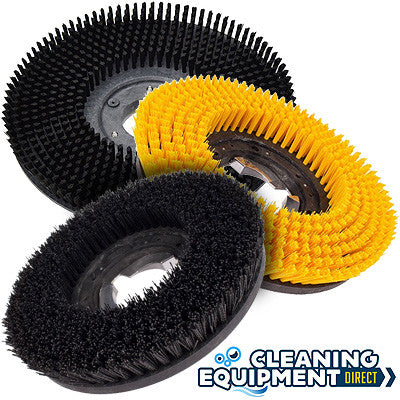
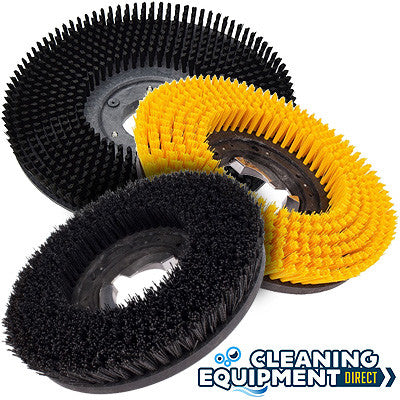
Many people and cleaning professionals know how to make great use of their automatic floor scrubbers. But while they can effectively utilize the machine, they often struggle with which floor scrubber brush to use when the time comes to replace it. With so many choices the task can be a bit daunting at first glance. Different brushes mean different uses for different machines and tasks. That’s why we’ve compiled a list below to help you with the process.

1.  Union Mix:

Medium grade natural fibers for polishing finished floors with standard-speed equipment.  Recommended for use in place of white pads.

2. ProLite:

Bristles are made from light-duty polypropylene for general scrubbing when you do not want to scratch or remove finish from the floor. Recommended for use in place of red pads.

3.  Prolene:

Polypropylene material for medium-duty scrubbing on concrete, terrazzo and vinyl floor tile.  Recommended for use in place of green or blue pads.

4.  Magna Grit:

For extreme heavy-duty scrubbing or stripping of floors. This brush has extra large diameter silicon carbide grit impregnated synthetic bristles. Recommended for use in place of black pads.

5.  Dyna Grit:

For aggressive, heavy-duty scrubbing or stripping of floors. Recommended for use in place of brown pads.

6.  MidLite Grit:

For general purpose scrubbing of sealed or unsealed concrete, stone, terrazzo, quarry tile and other resilient hard floor surfaces. Recommended for use in place of green or blue pads.

7.  MidGrit:

For general purpose scrubbing when you need a lighter action for sealed or unsealed concrete, stone, terrazzo, quarry tile and other resilient hard floor surfaces. Recommended for use in place of green or blue pads.

8.  AgLite Grit:

For light scrubbing when used wet; buffing or polishing when used dry on urethane coated, sealed concrete or other resilient hard surface floors. Recommended for use in place of red or white pads.

9.  Short Trim Pad Holder:

Made with a structural foam block and center ring for correct pad centering. It has a “shower feed” design for getting solution to the floor.

We hope this information helps. If you have any other questions at all, please don’t hesitate to Contact Us!!! And remember that www.CleaningPartsDirect.com has all the brushes you will need at unbeatable prices as well!

Squeegee Blades – Whats the difference?


Linatex squeegee blades:

The all-around best-performing and longest-lasting squeegee blades are made from linatex premium natural
rubber in a signature red color. These blades would be the best choice in applications where the floor is not smooth or even and there is an oily environment. They are typically more expensive than the gum rubber blades, but that additional cost will be recovered by the additional lifespan. These squeegees have excellent flexibility for more consistent seals and water pickup as well as rip-resistant durability for long-term wear.

Polyurethane / Urethane squeegee blades:

Typically opaque. Urethane squeegees are highly chemical-resistant and work especially well in industrial environments. With oily or rough surfaces, and on old or uneven floors there is no better choice. They are typically the most expensive blades, but they will last a very long time in the correct application.

Gum Rubber squeegee blades:

Typically white or tan. Not recommended for oily environments. Gum rubber absorbs oil and the material will begin to lose its structural integrity, becoming very wavy, and the cleaning ability will be lowered. Gum Rubber squeegees work very well in situations where the floor is smooth and even like shopping malls, grocery stores and other public spaces. Gum rubber squeegees ensure maximum water collection on smooth and tiled floors, leaving them dry and safe for pedestrians. The gum rubber squeegees will wear faster than any of the other types of squeegee blades but are usually the least expensive.